White Cashile handbag
The Cuckoo's CallingThe White Cashile handbag is a custom-made white leather bag sent to Lula Landry by Guy Somé, distinguished by its detachable silk lining printed with an African design. Its importance emerges from the contrast between its glamorous, customizable surface and its concealed interior: when Cormoran Strike searches the bag in Lula’s adoptive mother’s wardrobe, he finds a folded pale blue paper hidden beneath the board supporting its base. The handbag becomes both a personal gift and the discreet hiding place of evidence.
Design and Provenance
Guy Somé had sent Lula handbags from a new range. The white Cashile bag was custom-printed for her with an African pattern, and its silk lining could be removed. The construction was not merely ornamental: the lining zipped in and out, could be exchanged for other linings, and could also be used as a scarf. Its metal-edged finish and vivid print made the bag a carefully designed fashion accessory, with a distinctive mechanism that would later matter to the investigation.
Ciara Porter encountered the bag when she unwrapped it among the handbags Somé had sent. She envied Lula the custom-made white one and jokingly asked whether Lula would leave it to her. Lula answered seriously that she was leaving everything to her brother, adding that she was sure he would let Ciara have anything she wanted. Ciara recalled this exchange to Strike while he was investigating Lula’s death; he observed her closely, but her account appeared to come easily and frankly. The remark links the handbag to Lula’s stated plans for her possessions and gives it a place in the question of what she expected to happen to her estate.
A Detachable Feature Becomes a Clue
Later, while speaking with Ciara, Strike returned to the bag’s unusual lining and asked why a handbag would have one that detached. Ciara explained its practical and aesthetic purposes: owners could customize their bags, buy several linings and switch them, or remove one and wear it as a scarf. Her light-hearted explanation also provided Strike with a precise account of how the object was assembled and how its interior could be accessed.
The construction mattered because the concealed paper was not simply lying loose inside the bag. In the wardrobe, Strike found a cluster of new handbags in different colours, squeezed onto a high shelf among dresses, coats, bags and hats. He identified a blue bag with the GS logo, then selected the white Cashile. Its African-print lining matched Ciara’s description. Strike unzipped the lining and drew it out like a scarf, exposing the rough inside of the white leather.
The Hidden Paper
At first, the bag’s interior appeared empty. On closer inspection, however, Strike noticed a pale blue line along the side of the stiff, cloth-covered board that held the base in shape. He lifted the board and found a folded piece of pale blue paper beneath it, covered in untidy handwriting. The bag’s lining and base had together obscured the paper from an ordinary view into the main compartment; noticing the blue edge and removing the board exposed what had been concealed.
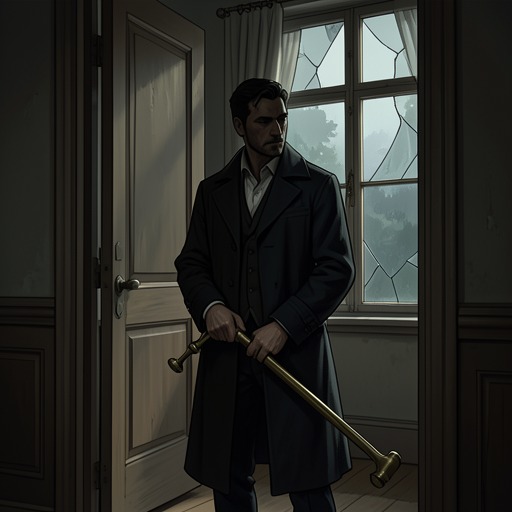
Strike did not read the paper in the wardrobe. He opened it only enough to place it in a clear plastic bag, then returned the handbag to the shelf with its lining bundled inside. He continued searching the wardrobe, where a safe with a digital keypad stood behind another door, but movement in the bedroom interrupted his trial of the keypad. He concealed the plastic bag and went back to find the Macmillan nurse bending over Yvette Bristow. The find therefore becomes a preserved piece of evidence rather than an immediately interpreted message; the scene establishes where it was hidden and how Strike recovered it without yet disclosing its contents.
Narrative Significance
The handbag’s role depends on details that initially seem incidental: a gift from Guy Somé, an African-print lining, and Ciara’s explanation of its detachable design. A feature made to allow customization and convert silk into a scarf gives Strike a way to inspect the interior; the stiff base then directs his attention to the paper concealed underneath. The object changes, in effect, from a luxury accessory into a hiding place whose construction carries investigative significance.
Its significance also rests on the tension between display and concealment. The Cashile is designed to be distinctive and personalized, yet the evidence lies below its visible lining and shaped base. The account of Lula’s intention to leave everything to her brother gives the bag an additional connection to her stated arrangements, while the concealed note introduces a material trace that cannot be explained by the bag’s decorative purpose alone. In the investigation, the white handbag is not simply an expensive possession: its design determines how a hidden document can remain out of sight and how Strike can find it.